An offer for small wine & spirits brands

Free Ruby CRM for your brand.
A $300 value.

Ruby CRM helps you find your customers. Two users and a 30-minute setup call. You pay nothing.

No credit card. No contract. No setup fee.

What you get

Ruby CRM, 2 users$150 value
Setup and training call, 30 minutes$150 value
Your cost$0
Claim the free CRM

Why we built this

Most small brands keep their accounts in a spreadsheet. Or in their head.

Here is how it usually goes. You get into a market. You work it yourself, or with one other person. You walk into stores and bars, you pour, you leave a sample, you get a maybe.

Then three weeks pass. You are in a different city. Somebody asks: what happened with that wine bar on the east side — the one that liked the rosé? And the honest answer is that you are not sure. It is in a text message somewhere. Or it was a note on your phone that you replaced with a grocery list.

The work was real. The record of it was not. So the follow-up never happens, the account goes cold, and the next time you are in that city you start over from zero.

That is the whole problem. Not strategy — memory. Ruby CRM fixes the memory part, and we will give it to you for nothing.

What it does

Four things, in the order you would actually use them.

Everything below is a real screen from Ruby CRM. Nothing here is a mockup.

1

Pick who you want to sell to

More than 350,000 active licenses are already loaded — state-verified, all 50 states. Stores, bars, restaurants. You do not build a prospect list; you filter one.

Search a city, split on-premise from off-premise, and every dot on the map is a real licensed account you are allowed to sell to. Here: on-premise accounts in metro Atlanta, 1,647 of them in the visible area.
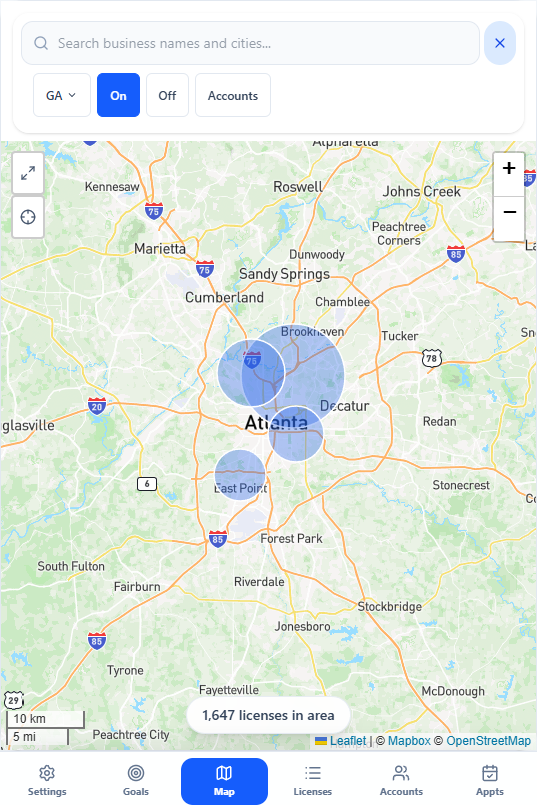
Ruby CRM mobile map showing active on-premise license clusters across metro Atlanta with 1,647 licenses in the area

The map, on a phone. Account data backed by state license records.

2

Record the visit before you get back to the car

Five buttons across the top of every account: Emailed, Called, Set Appt, Recap Visit, Order. One tap each. That is the entire data-entry burden.

Who you saw, what you poured, what comes next. Dictate the note if your hands are full — there is a microphone in the box. The next time anyone opens this account, the whole history is sitting there under Past Activities.
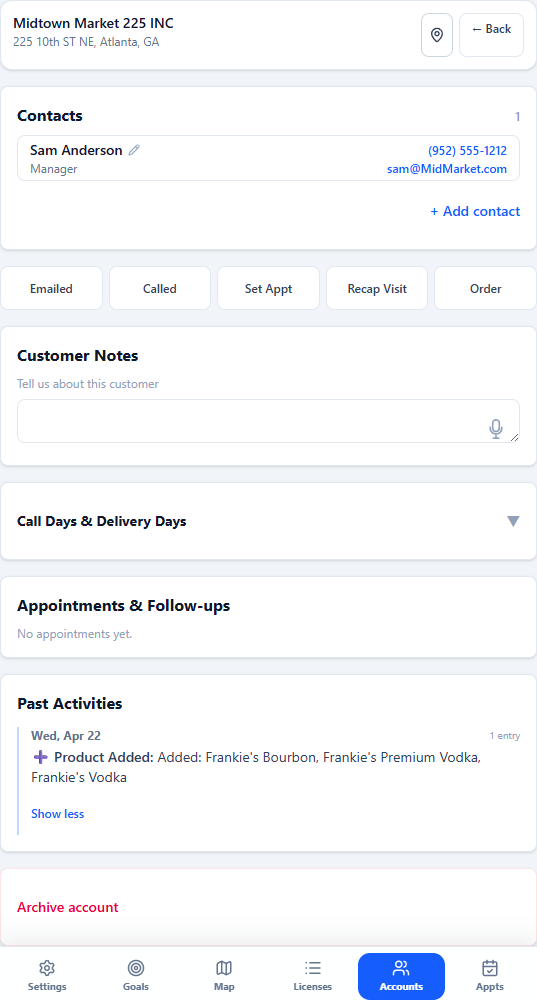
Ruby CRM mobile account view for a Midtown Atlanta market showing the contact, five one-tap logging buttons, a dictatable customer notes box, and past activities

One account. Contact, one-tap logs, notes, and everything that has happened here.

3

When a store says no, write down why

A no is not a dead end. It is a dated fact with a reason attached. Too expensive. Already carries three from that region. Buyer is out until spring. Shelf is set through Q3.

Put it in the notes and it stops being a bad memory and starts being a reason to come back at the right time — with the right price, or the right SKU, or just later. A lot of what a small brand wins is a second attempt at a store that already said no once.

The same account, six weeks later

“Passed in April — buyer said the by-the-glass rosé slot was locked through summer. Told me to come back in August.”

You will not remember that in August. Ruby will, and it will be the first thing on the screen when you walk back in.

4

Get a simple report every week

Calls made, placements won, what is still open — per account, per week. It builds itself out of the taps from step 2. Nobody assembles it on Sunday night.

If you have an importer, a distributor, or an investor asking how the market is going, this is the answer. Screenshot it and send it.
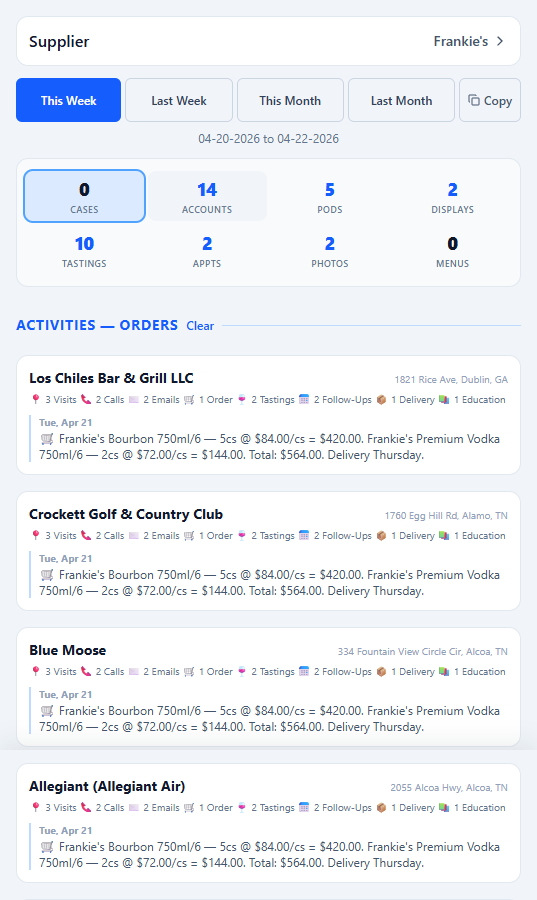
Ruby CRM Goals tab showing weekly totals for accounts, PODs, tastings, and displays, with per-account activity and order details

The weekly, without writing the weekly.

And when you sit down at a desk

The same data, wider. Map, license list, and your saved accounts side by side — for planning the week instead of logging it.
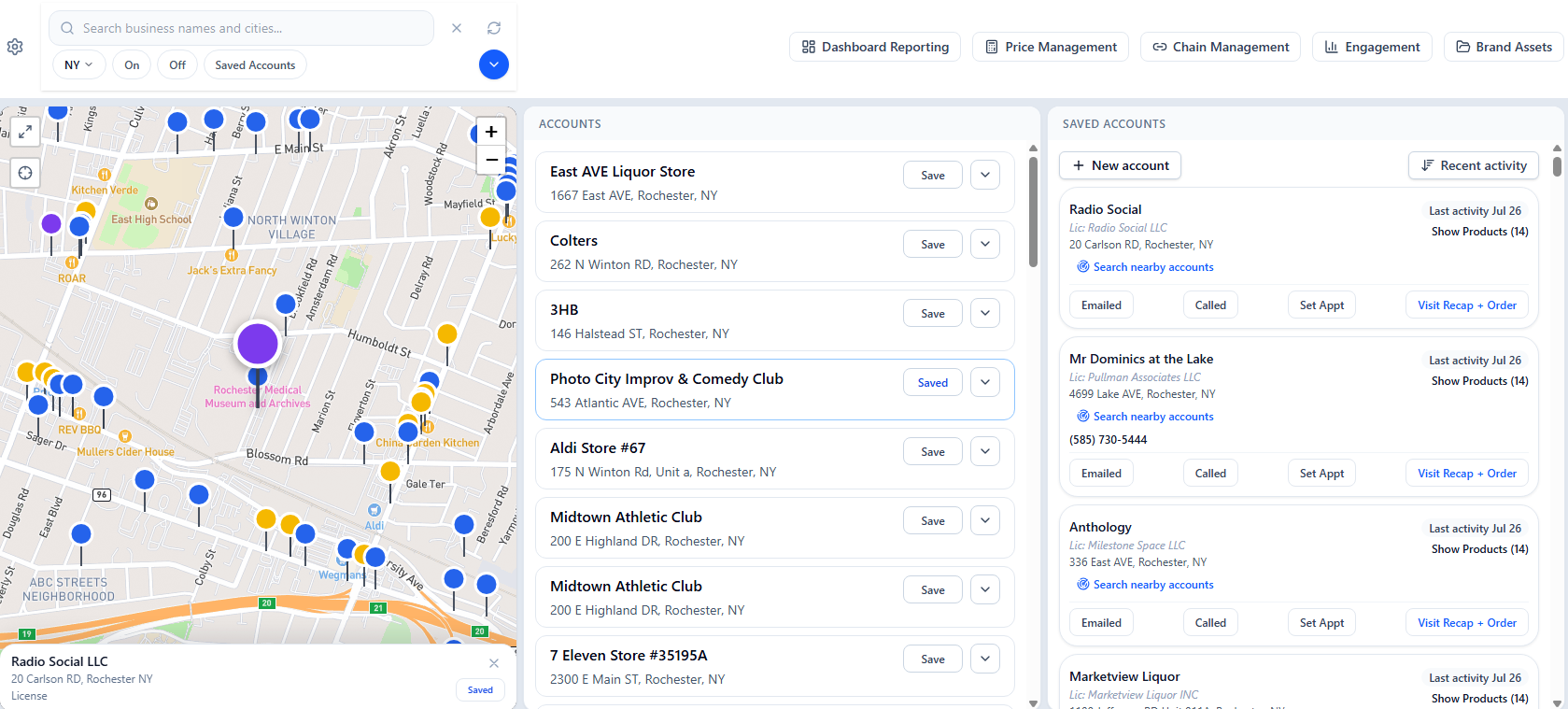
Ruby CRM desktop workspace showing a Rochester NY map with license pins, an accounts list, and saved accounts with one-tap activity logging

Live view from the Ruby license intelligence platform.

Who this is for

Small brands that want to sell in more places.

You do not need a sales team, a data budget, or somebody who already knows what a CRM is. If you are one or two people carrying your own brand into new accounts, this is built for exactly that.

  • ✓ You are a small brand — wine, spirits, or RTD
  • ✓ You want to sell in more places than you do today
  • ✓ Your accounts live in a spreadsheet, a notes app, or your head
  • ✓ One or two people do the selling

The offer

$300 of software and setup, at no cost.

Two Ruby CRM users is a $150 value. A 30-minute setup and training call with someone who knows the wine and spirits business is another $150. You pay neither.

Why free? Because small brands grow, and the ones that grow eventually need pricing, depletion tracking, and a system to run the whole operation. We would rather be the software you already use than the software somebody sells you in three years. If you never buy anything else, the CRM is still yours to use.

$0

for a $300 package

Ruby CRM, 2 users$150 value
Setup and training call, 30 minutes$150 value
Your cost$0
  • ✓ 350,000+ state-verified licensed accounts, all 50 states
  • ✓ One-tap logging: email, call, appointment, visit recap, order
  • ✓ A reason recorded on every account that says no
  • ✓ Weekly activity report, built automatically
  • ✓ Phone and desktop
  • ✓ No credit card, no contract, no setup fee
Claim the free CRM

How to get it

Three answers and a phone call.

1
Tell us three things

Your brand name, the states you sell in, and how many products you have. Put them in the message box on the contact form — that is all we need to set you up.

2
We send your invite

Your workspace comes loaded with the licensed accounts in the states you sell in, ready for two users.

3
We book your call within a week

30 minutes, live. We set up your brand, your products, and your first target list with you on the line.